Wednesday 13 October 2010

Location, Location, Location

A few of the places we laid to rest.
Bike parked in the inner courtyard of the hotel, Rabat, Morocco.

Outside the hotel in Marrakech, Morocco.

Bike in the hotel foyer, Tan-Tan, Western Sahara.

From inside a Berber tent on Western Saharan side of Mauritanian border.

Camping at Chez-Abba, Nouadhibou, Mauritania. The sand was blinding white.

Hotel Kaarta, Kaarta, Mali. It's an hotel, honest.

Bamako, Mali. Tent pole makes an improvised clothes line.

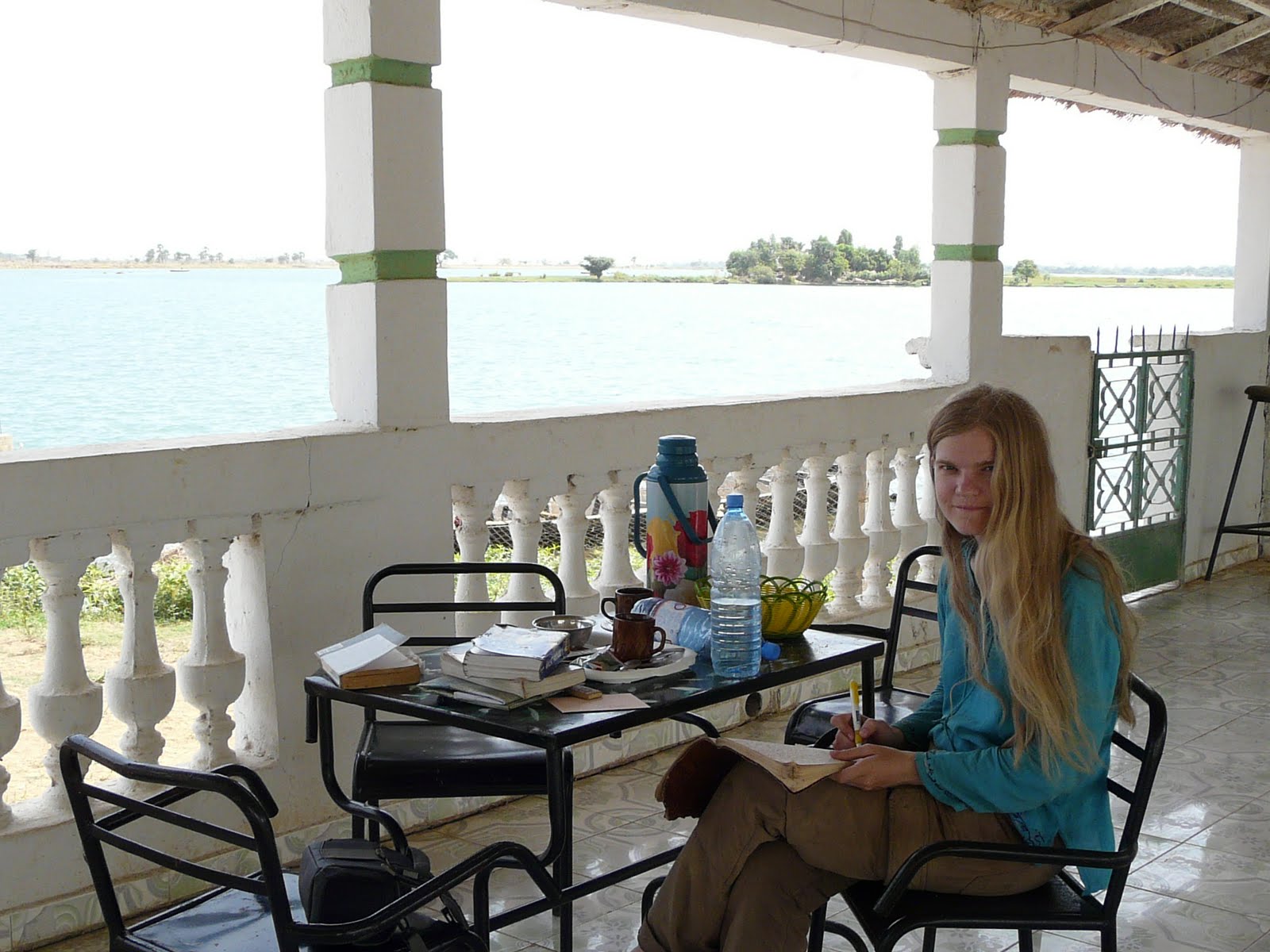
Segou, Mali. Breakfast at the edge of the Niger.

Mud walled Chez-Baba, Djenne, Mali.

We pitched our tent on the roof of a mud building in Bambara-Maounde, Mali.

Bush camping, Mali. Off the track on the way to Timbuktu. The sand was covered in thorny seeds.

Bush camping near Banfora Falls, Burkina Faso. The bike was covered in bat droppings the next morning.

Mole National Park, Ghana. We discovered a family of warthogs sleeping under the platform.

Wednesday 28 April 2010

Goodbye Africa

Accra, Ghana. 8220 miles

So this is it. This is the last blog entry from Africa as we fly back to London tonight.
For the first time since Fez, we are gan Capall/sans cheval/without horse.

On Monday the bike was emptied of fuel and oil, strapped to a pallet and put in the hold of a London-bound cargo plane.
We hope!
From there we take the final road trip back across the UK to the boat for Ireland.
Is there any point in us hoping for 35 degrees when we get there?

It has been an amazing experience and we both love that our understanding of this massive continent has been marginally improved.
We've had some challenges, some adventures and plenty of fun but overall we have to say that the trip was easy.
The people here made it so.

Thank you to everyone who followed our trip and to everyone who gave comments and encouragement. We appreciated everything and had many a laugh at various comments and e-mails you sent.

We'll do a wrap-up e-mail when we get back home.
Bye.

Saturday 24 April 2010

Water

Elmina, Ghana. 8036 miles

Every day or two, we have to remove the map from its transparent pocket in front of me on the petrol tank. We look for our intended destination and try to refold the map so that the day's route is visible.
Some days, we need to refold the map mid-way through the journey.
Each time we refold, there is a small sense of achievement at having covered the few inches in front of us.
Every few weeks, we changed the map for a new country. It was always exciting to fold the old worn country and pack it away while taking out a new fresh country ready to be moulded as we would require.
Towns, rivers and even map symbols that we'd become familiar with would disappear and we would have to learn again how to decipher the new colours and markings.
Rarely however, would we take stock of how far we'd travelled in Africa overall.

That full distance was clearly brought home to us last week when we rolled over a hill and the grand expanse of the Atlantic Ocean opened out in front of us once more.
The maps are good but when the view in front of you lets you know that you have driven across a section of a continent, it really comes home.
We last saw the Atlantic Ocean in Mauritania. We were heading south and it was then to our right as we rode down the coastline. Four countries later and as we still ride south it appeared directly in front of us.

Tropical Africa is entering its rainy season. As I mentioned, we escaped a heavy shower in Kumasi. On the ride to the coast we were not so lucky.
We had decided to find a remote part of Kakum National Park. The directions from the locals were progressively confusing; they couldn't understand our request and we couldn't understand their replies.
We found ourselves 10 miles from tarmac on an increasingly narrow dirt track which cut its way through dense vegetation. The route became more steep and rock-strewn while water gulleys cut deep ravines across the road.
At the top of one particularly rough hill, our baggage broke loose. While adjusting it, some locals arrived. We chatted and one woman gave us clear directions for our destination. Not surprisingly, we were on the wrong track.
As we started to retrace our steps, a pregnant cloud darkened the sky accompanied by rolls of thunder. The heavens opened. Within minutes we were soaked through with warm water. The track which had been dirt, turned to mud and the water gulleys filled and overfilled with fast running rivulets. We considered waiting for the rains to pass but the puddles we'd passed on the way were turning into flood lakes. We carried on. The bike squirmed about in the slop so I tried to follow the rivulets where the gravel had been washed. We waded through floods preceded by a bow wave that our pinasse couldn't create on the sand-banked Niger last month.
Finally we made it back to dry tarmac and got off the bike to wring out our clothes.
We arrived in Cape Coast that night and too much water was replaced with no water in the guesthouse.
We needed have worried though, we discovered later that our sleeping bags had soaked up plenty!

Monday 19 April 2010

Life as a pillion passenger

"It must be so boring sitting on the back of a bike?" " Is it not really uncomfortable?" "Isn't it tiring being on the back all the time?" These are all questions I've been asked during this trip, and the answer I always give is a resounding NO!!

Motorcycle travel is actually THE best form of travel for a myriad of reasons. The bike affords us amazing freedom; freedom to travel off the beaten track, follow paths that branch off the main routes, get really close to waterfalls and riverbanks - places no bus or 4x4 can reach! Another huge factor is that our schedule is completely our own, which is an amazing feeling. People sometimes ask "Where are you going tomorrow?", and we often reply that we don't know yet. That's a really liberating feeling. I've travelled a lot by bus on other trips. Of course, that has its own appeal and charm, but on a bus you can't ask the driver to stop because you see something really interesting and you want to explore it further, or you want to buy a snack from a street vendor or "use the local facilities".

But why is it so good to be a pillion passenger?
The great thing about the view as a pillion passenger is that you are completely free. Unlike being on a bus, where one only has a piece of a window to look through (if you're lucky), on the Capall, I have 360 degree views of everything. My eyes have been fortunate enough to follow the path of eagles swoop above us. I've waved frantically at passing children until they were no longer in view. I've savoured every second of amazing pink sunsets. And you really can't get the same experience in an air-conditioned car. On the bike, you have the full sensory experience - you feel the intense heat of the sun on your face when you climb aboard, and the satisfying cooling wind that ensues as soon as the bike moves; you smell the street stall food as you drive through towns; you hear the cicadas chatter and the children squeal in excitement at the sight of the strangers passing through! When you stop, you can immediately look a local person in the eyes and shake their hand.

Of course, trusting your driver 100% is what makes this possible. I am completely comfortable in my pillion seat, as I am completely confident in Mike's ability to handle every driving situation. So comfortable, that the only times I hold on to the sides are when we tackle rough pistes. Knowing that Mike will always make the right decision means I can completely relax. I often watch and anticipate traffic with him, as it's a good adrenalin-rush. But, similarly on open roads, I'm often in my own little dream world, opening sweet wrappers with my free hands, drinking from my water bottle, and scratching Mike's back on request!

So, I cannot recommend motorcycle travel highly enough. I'm sure all the bikers reading this will agree, but many of them have never ridden pillion, so just thought I'd give you all a little insight into my persepective for the past 13 and a half weeks. Though that driver's seat does look pretty inviting too....... Maybe next time.......

Friday 16 April 2010

Our final African country

Kumasi, Ghana, 7443 miles from home

Burkina Faso

Burkina Faso means 'Land of honest men'. It's an apt name but it could easily have also been named, 'Land of a million mopeds'. The few cars on the roads, which are invariably taxis are always swamped by mopeds, mobylettes and motorbikes. This gives the streets of the big cities a frenetic feel. Ouagadougou, the capital city with the best name in the world, has road-lanes dedicated to motorbikes. We used this to our advantage many a time but then when we needed to push our way through traffic at junctions and roundabout, the Capall has enough presence to be noticed and can't be bullied.

Burkina is a relaxed country. It doesn't have any of the big name attractions that Mali has but the main attraction is simply the people and their easy-going way of life. Everything is doable with no problem. Nothing is too big, awkward or fragile to be carried on a moped; tray of eggs or PA speaker, it's all easily managed.

Music was a big part of our two weeks in Burkina Faso. In Ouagadougou we saw a live band playing modern African music with vocals and percussion only and in Bobo-Dioulasso we saw an electric band playing African blues. Bobo-Dioulasso seemingly had live music from every bar and cafe and it was where Madou, a good humoured Muslim Rasta gave us two hour djembe drum class.

After travelling for 11 weeks and meeting only one other motorcycle traveller, in Bobo we met three all at once. Kobus was riding his BMW F650 from Holland back home to South Africa. Danish Mick was riding his 1996 Honda VFR750(!) to South Africa and in Senegal, he had joined with Ian from England who was riding his Yamaha Tenere all the way down too. We had a good couple of evenings swapping travel stories and experiences and the bike stories were nicely offset by Yvan and Marie, a French couple who are coercing their yellow and black 1984 Citreon Acadiane (2CV) van around West Africa.

After Bobo, we travelled to Banfora waterfalls and the versatility of the motorbike came into its own as we were able (and allowed) to ride down a narrow dirt footpath and camp right at the base of the falls.

We left Burkina Faso the same manner that we entered; by a long dusty road leading to a solitary border post where a relaxed official stamped and signed us through with no hassle. Honest men indeed.

Ghana
Each country we've visited has its own unique feel and we saw the changes happen gradually.
Ghana on the other hand was a major step-change. All at once the language, the religion, the landscape and the climate all stood out as being quite different.
After 3 months of murdering the French tongue, we are now back to English although the Ghanaian accents are thick enough to cause us to concentrate just as hard.
Ghana is the first country which doesn't have a Muslim majority and noticing this can't be escaped. Each town has an over-abundance of churchs and ministries but even more obvious and very entertaining are the enthusiastic names of shops and businesses. Some of our favourites have been, 'God is One Filling Station', Thy Kingdom Come Beauty Salon' and 'A Deeper Life Genuine Opel Parts Supply'.
We have definitely left the desert behind. The landscape is thick vegetation and lush greenery. The roads scythe through hills covered in thich trunks, vines and expansive leaves.
However, the water that allows this beautiful change generously donates high humidity to the air. I'm sweating so much my sunglasses won't stay put and Linda is considering joining the women here and shaving her head to cool down.

The jungle and greenery allowed us to go on our first safari. After a 2 hour grind along some rough tracks, we spent 2 nights in Mole National Park.
A 6am start saw us go for a 2 hour walking safari. 10 minutes after walking out of the camp-site our guide held up his hand for quiet and three adult elephants walked out of the trees and across a clearing less than 50 metres from us.
After that start, we watched more elephants nervously share water hole space with a horde of crocodiles, while antelope darted through the trees in the background and troops of baboons grunted in the trees.

We spent the last two nights in the city of Kumasi which is home to Africa's biggest market. It was like a colourful shanty town of corrugated sheet stalls and one step into its edge caused us to be dragged slowly with the crowd into its labrythine interior. The market spills onto the streets and the shops spill onto the street. Linda wondered what the shopkeepers and stall holders do when it rains but we were glad to not find out as back at our guesthouse, a gale blew without warning and the heavens opened. Blankets and sheets of rain fell and we hoped that the tent strapped to the bike would be okay.

This morning we woke to a scorching sun in a clear blue sky and the only effect on the bike was that some of our authentic Africa dust was streaked.

Wednesday 31 March 2010

Timbuktu/Tombouctou/Timbuctoo photos

Road to Tombouctou is paved with.....deep sand. That one was deeper than we expected!

Dyingerey Ber Mosque

Discovering Tombouctou

Tombouctou streets

The Grand Mosque, Tombouctou on the site of the world's first university

Linda sharing Malian tea in the desert.

Camel trip with the Tuaregs

There's another new post below this one - keep reading!


The journey south


Deep in the Sahara desert, salt is mined and carried in slabs by camel caravans to Tombouctou (Timbuktu). From there it is transported by traditional wood and canvas boats called pinasses down the Niger river to Mopti. This route and method have changed little in hundreds of years despite the advances of modern technology.


For one week in March, the 2 pinasses of Aliyou Hamadoun carried 30 tonnes of salt, 10 tonnes of grain, several baskets of dried fish, 2 Malian families, 1 BMW R1100GS and 2 sunburnt Irish adventurers along this famous route.


March is in the dry season in Mali and the resultant low water levels cause problem for the navigation of these boats. Sandbanks lurk just beneath the surface. The drivers (Bozo people) know every inch of their river, having lived in harmony with the river for generations. They weave paths between the sandbanks, which is particularly challenging at nightfall! We were prepared for a journey of 3 days and 2 nights, and had the appropriate rations of drinking water and biscuits that we felt would safely see us throught the trip. 7 nights later, thanks to low water levels, and many large sandbanks, we whooped songs of joy as the lights of Mopti were visible in the distance. We were worried that we might be hallucinating, as we had become accustomed to the slow pace of life - early mornings, early nights, no lights in the river villages and a distinct lack of consumer goods (the ubiquitous Coca Cola signs)! The most challenging aspect was never knowing when we'd get to Mopti. Mike might disagree, and say the most challening aspect was being roused at 6am to jump into the river and start pushing the pinasse as we hit yet another sandbank. Mike shattered any colonial myth that the white man lies relaxing on the boat while allowing the natives to do the hard physical work. I, on the other hand, was happy to abandon my feminist principles, and allow the men to push us out of difficulty on every occasion!


Our pinasse carried a family of 2 brothers, the wife of one of them, and 4 children (age 6,9, 11, 14). We soon discovered this was their home. The children's school and playground was the 80 ft pinasse, complete with cargo. The river was their home, and providesd all they appeared to need. The river served as toilet, shower, washing machine, dishwasher, cooking water, drinking water and rubbish bin. They treated us as part of the family, and provided us with 3 meals a day (rice, rice and rice - with fish and gravy for lunch!) You know you're really considered a big sister when you go to the part of the pinasse where the toilet bucket is kept, and you're no longer afforded any privacy, but instead jokingly poked in the arm and told to hurry up!


The kids were completely fascinated by us. They were quite shy at first, and seemed genuinely afraid when I sang a song and tried to play a clapping game with one of them. They spoke only their own language (Sorhei), whereas almost all Malians speak quite good French. We assume this was because, like their parents before them, they had never been to school. It was surprisingly difficult to communicate with kids that age. We couldn't kick a football with them, and the signs we used and thought were universal didn't see to be understood. Eventually we discovered playing cards, and taught them a variety of games, and how to count to 10 in French. I was also quite touched when they named their doll Linda in my honour!


It was a facinating trip watching the steady stream of fisherman in their pirogues and similar cargo pinasses. We gained some insight into traditional village life along the Niger, were in awe at our first sightings of hippos in the wild, and captivated by the beautiful birdlife passing overhead. So, we were glad it took that little bit longer than planned. And we survived with the daily meals and the water and biscuits we had. You see, being Westerners, one always assumes you need more than you actually do!!


Our boat on the right, the bike's on the left.


Linda relaxing on a bed of salt slabs. (That's a faded Malian flag, not an Irish one!)


An Capall as cargo.


Niger by night.


Hippos out for an evening


Typical river-side life.


Wild Irish fisherman pushing the Pinasse


In Mopti, we negotiated with 5 men for them to lift An Capall from the pinasse back to dry land. From here, with 2 sets of stiff legs, we rode to Bandiagara. This is the gateway to Dogon country, where we undertook a 3 day trek through intriguing villages built along the top and foot of an 80 metre high escarpement. The Dogon region has held fast to traditional ways of life. The religion is Animism (worship of ancestors and nature), and gender roles are clearly delineated. The men hold village meetings in low roofed woden structures: so low you have to crouch when inside, thereby eliminating any possibility of fighting. A woman's primary role is to reproduce, and the Dogon women are strong - grinding millet, carrying branches on their heads, usually while pregnant and with another baby strapped to their backs! Life in post-recession Ireland never looked so appealing! The scenery was absolutely breathtaking, and at times reminded us of the Burren in County Clare and the Kimberleys in Australia. We were treated to traditional dancing (very fast footwork!) and our guide introduced us to some fascinating old village people. The kids had no problem in introducng themslves to us. Mike says I look like a female Jesus with dozens of kids trailing behind me!


We've now crossed into Burkina Faso. More details on this beautiful country soon.........


Dogon village


Linda and our guide, David about to tackle the steep descent down the escarpement.


Road out of Mali and into Burkina Faso


Saturday 27 March 2010

Toubabs and Tuaregs in Timbuktu!

Bandiagara, Mali. 6080 miles by road / 350 miles by river!


Africa can't be tamed.


As soon as you think that you're getting a handle on it, it throws something new and unexpected in your path.

There are clocks here but they seem irrelevant as Africa runs to its own beat and all you can do is listen and wait and fall into its rhythm.

Since we last wrote, the adventures have come at us faster than we could imagine.


After Bamako, we followed the path of the Niger river to the historic towns of Segou and Djenne.

Segou was where the Scottish exlorer, Mungo Park first stood at the banks of the Niger and determined it's west-east flow. As we had breakfast on a terrace watching the fishermen push the pirogues out, the current was so gentle that the morning breeze pushed the waves upstream.

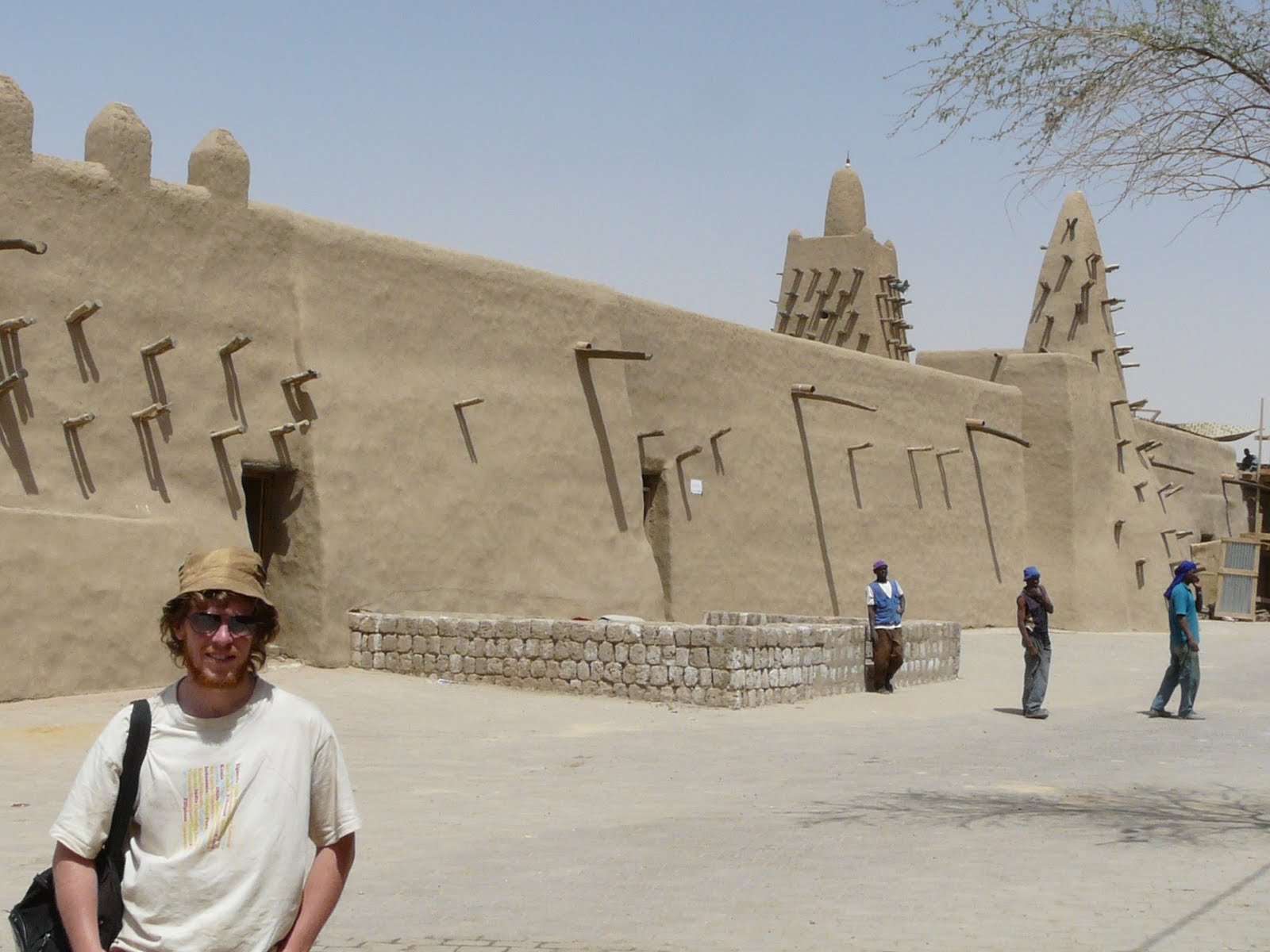
Djenne is an island town of mud walled buildings. The centre piece is the 5 story mud walled mosque towering over the market square like a dirt fairytale castle.
We crossed onto the island by means of a small car ferry. But being Africa, the ferry docked straight onto soft sand of the beach.
I've mentioned my interest in riding on soft sand already and when we were leaving the island the soft sand played it's part in a dramatic exit.
The ferry couldn't dock properly so the driver dropped both ramps steeply down into the water about 3 metres from the waters edge.
This required the vehicles to take run at the ferry, through the soft beach sand, into the water on the softer sand and thump, up onto the ramps.
Linda dismounted and pointed the camera.
I lined up; held my breath and let the clutch out.
The sand was fine, the water was grand. but when the front wheel hit the ramp the Capall reared up onto its rear wheel and came down at an angle on the ramp.
At this stage, the bike was only half on the ramp and I was commited so I kept the power on.
The rear wheel hit, to similar effect and bounced the bike even more towards the gap between the ramps.
It did briefly occur to me that this mightn't be my finest moment in biking; just as the front wheel fell off the ramp.
For a Walt Disney minute, the bike dangled with the front wheel out over the water and yours truly leaning back hard, until about 10 local men swarmed the bike and we picked it up back onto the ramp.
Somehow, the only casualty other than the blood vessels in my face, were the front bash plate mounts which did their job and protected the engine.

Two days later we were in Douentza.
From here we headed north off the tarmac on the 150 miles towards Timbuktu.

Timbuktu is that semi-mythical town that we've all heard of but don't think it real.
It had drawn explorers from Europe as far back as the 15th century and most didn't return.
It's not as difficult to reach now but it still ain't no picnic!

We had heard discouraging stories about this section of piste and very quickly found out that they were all true.
Put simply, it was the worst 150 miles I have ever driven.
Many years of heavy trucks had pushed the hard packed dirt of the road into a series of corrugations.
The locals call them escalier (steps) and they were the same effect as driving on 150 miles of cattle grids.
We took three days, cheering when we reached another stone marker telling us that we had just passed another 5 km in the prevous 20 minutes.
At the end of the first day and 60 miles, we rolled into the town on Bambara-Maounde. We were grateful for the stop and the cold drinks but mightily confused as Bambara-Maounde was about 40 miles due east of where the map said we should be.
Africa was up to its old tricks; in this case our Mali map, drawn in 1985, updated in 1992 basically showed the road going the wrong way.
We're still not sure where we actually went but we were always happy as long as the 5km stone marker kept appearing. Every 20 minutes........

As I started the bike in the morning at Bambara; the oil level indicator window blew out the side of the engine with most of the oil following it.
I couldn't blame it - I wasn't too keen on setting off on more of the same track either.
About an hour later, it was back in place with chemical metal and instant gasket but this was a very lucky save. If this had blown out while we were on the road, the first I would have known would be that sound of pistons welding themselves to cylinders followed by a bang and then silence.

On the third day we entered Timbuktu.
Even after being there, it's still semi-mythical.
Narrow alleys led a labryth through mud-walled building which haven't changed in 1000 years.
Tribes and ethnicities meet and mix; Songhei, the orignal settlers; Fulani and Sorhei, the river people; Tuaregs, the blue-robed nomads of the desert; and Toubabs, us!
Since Senegal, every child that sees us shouts "Toubab, Toubab"! At first we thought it meant hello or welcome, but eventually discovered it meant, simply and accurately, White Person.
And that's how we're known. Children seem to be able to call Toubab before they can walk and it's the backdrop chorus everywhere we go.
Timbuktu is on the edge of the desert and we took a trip into dunes in a way that The Capall couldn't manage. We took the original ship of the desert and tried not to fall off the back of wo camels.
The reference to ship must be because of the up and down motion the rider feels when they walk.

We have a lot more to tell but to give my fingers and your eyes a rest, I'll finish this post now.

We're leaving for Burkina Faso tomorrow but when we get there we'll tell you about the 350 miles by river! And no, I didn't drop the bike in the water.........

Friday 5 March 2010

Some more photos

We've found a decent internet connection so we're finally putting up some photos.
Malian village off the beaten track with great kids.


Senegal dust.


Fixing the Capall in Chefchaouen, Morocco.

Charming the snakes in Marrakesh?

Marrakesh sunset.

Mauritania. Sahara. Linda. Camels. Sand.

Impromptu music with Mauritanian holy men.

Linda surrounded by Senegalese kids in St Louis.

Parque de Langue de Barbarie, Senegal.


Linda being taught how to cook, Senegalese style. Louga.

Kids!

Thursday 4 March 2010

Dust and duct tape.

Bamako, Mali. 5220 miles from home.

Heat.
Habits learned in north Europe cause you to wait for the water to heat up before you step in.
Then you remember this is Africa and although hot water is unlikely, you really wish the water will stay cold.
It feels like the water has soap already mixed but it's actually the perfect film of sweat covering you.
This is 9am. If you left it any later to get out of the tent, the heat inside would start to drain whatever energy you have.

Bamako
Bamako is pure Africa. The city heaves in the heat as thousands of mopeds, laden with over-sized boxes buzz around while the crowds mill in the markets. Everything and everyone seems to be moving but the speed of the vehicles is offset by the deliberate, slow pace of the pedestrians. A slow pace to conserve energy in the sweltering temperature.

We're camped by the Niger. It's wide with many little islands and for me it's difficult to reconcile how easy it was for us to travel here with the many Europeans explorers who died trying to find this river 200 hundred years ago.

The other paradox is that while in many ways, this is a modern city, 60 miles from here people are eking out an existence on arid dusty land.

Driving
When we were planning this trip, we looked at maps of the continent with roads marked as being passable only in the dry season.
I wondered how the bike would hold up and I wondered how I would hold it up on the sand and gravel.
I have to say that our overall feeling has been one of surprise at how easy it has been.
That's not boastful - it's simply that the road conditions range between ok and perfect!
We've ridden over 5220 miles. In total, approximately 60 miles of that have been piste (dirt track). The rest has been asphalt with much of it billiard table smooth.

The bits that challenge can be grouped like this.
Non main roads into villages. These are usually dirt and dust but the surface is consistent and easy.
No Mans Land or either side of a border crossing. These are the worst roads as neither government wants to spend money for the other to benefit.
Road works where the traffic is diverted off the main road onto piste.
Towns! The lesser streets in most towns are dust, dirt and sand. Junctions are the worst where the sand is twice as deep.

I'm happy driving on the dirt and dust but the deep sand is horrible.
When we were planning how to load the bike we tried to keep the weight as even as possible between the wheels, but the natural and easiest place to put stuff is towards the rear.
So, especially when the fuel is low in the petrol tank, the bike is weighted toward the rear.
On most surfaces it's no problem whatsoever but in sand the rear wheel digs down and the front wheel lifts out and starts acting like a rudder.
At these moments, poor Linda has to hop off and walk past the difficult section. I stand on the pegs, leaning forward, let the clutch out quickly and power forward at 20kph with a spray of sand behind.

Dangers on the road? No.
We'd heard horror stories about the driving standards in Africa. This is our fourth contry and so far it's been grand.
Taxi drivers don't use the rules of the road but what's new there?
The main thing we've been watching for are livestock wandering on the road.
Cows, camels and pigs are easy to deal with as they lumber slowly across.
Goats scamper as soon as they hear the bike or the beep of the horn.
Donkeys are the most troublesome. They move quickly and usually at inappropriate moments.
Our nearest miss was a trio of suicidal donkeys who threw themselves in front of An Capall as if they were part of a Donkey Suffragette Movement.

The heat is the biggest factor for us to deal with. Our thermometer was reading 43 degrees yesterday and that's with the wind blowing over it.
Actually the wind is hot. When I open the visor of my helmet, I feel like I'm checking to see if a roast chicken is cooked.
We changed Linda's helmet to open-face which has cooled her down.
However, with the thick dust and the sweat and sunblock on her face, when she takes off the helmet she looks like a 1950's racing driver. As if I don't find her attractive already!

An Capall Mor
The bike is holding up the finest.
Three of the four indicators are held on with duct tape and the neutral light sometimes appears in 1st gear but that's the sum total of problems.
The off-road tyres are wearing but not significantly.
We've cleaned the air filter but haven't needed to change it. That surprised us as the dust is so thick.
Duct tape has been a major part of the journey.
It's held on bits of helmets, blocked holes in tubes of glue and in mosquito nets, holds on the intercom leads to our helmets, sealed the sides of the toolbox, stuck sunglasses together, and hold bits that we are finished with, but need to keep under the boxes.

Washing
The dust gets everywhere.
We ran out of clean(ish) clothes yesterday and so spent 4 hours hand scrubbing today.
And I mean scrubbing!

Hello
Finally, but certainly not leastly, a special hello has to go Baby Molly and Baby Jack who made their appearances in the last few weeks.
Welcome to this cool world and we look forward to having a chat with you when we get back!