Kumasi, Ghana, 7443 miles from home
Burkina Faso
Burkina Faso means 'Land of honest men'. It's an apt name but it could easily have also been named, 'Land of a million mopeds'. The few cars on the roads, which are invariably taxis are always swamped by mopeds, mobylettes and motorbikes. This gives the streets of the big cities a frenetic feel. Ouagadougou, the capital city with the best name in the world, has road-lanes dedicated to motorbikes. We used this to our advantage many a time but then when we needed to push our way through traffic at junctions and roundabout, the Capall has enough presence to be noticed and can't be bullied.
Burkina is a relaxed country. It doesn't have any of the big name attractions that Mali has but the main attraction is simply the people and their easy-going way of life. Everything is doable with no problem. Nothing is too big, awkward or fragile to be carried on a moped; tray of eggs or PA speaker, it's all easily managed.
Music was a big part of our two weeks in Burkina Faso. In Ouagadougou we saw a live band playing modern African music with vocals and percussion only and in Bobo-Dioulasso we saw an electric band playing African blues. Bobo-Dioulasso seemingly had live music from every bar and cafe and it was where Madou, a good humoured Muslim Rasta gave us two hour djembe drum class.
After travelling for 11 weeks and meeting only one other motorcycle traveller, in Bobo we met three all at once. Kobus was riding his BMW F650 from Holland back home to South Africa. Danish Mick was riding his 1996 Honda VFR750(!) to South Africa and in Senegal, he had joined with Ian from England who was riding his Yamaha Tenere all the way down too. We had a good couple of evenings swapping travel stories and experiences and the bike stories were nicely offset by Yvan and Marie, a French couple who are coercing their yellow and black 1984 Citreon Acadiane (2CV) van around West Africa.
After Bobo, we travelled to Banfora waterfalls and the versatility of the motorbike came into its own as we were able (and allowed) to ride down a narrow dirt footpath and camp right at the base of the falls.
We left Burkina Faso the same manner that we entered; by a long dusty road leading to a solitary border post where a relaxed official stamped and signed us through with no hassle. Honest men indeed.
Ghana
Each country we've visited has its own unique feel and we saw the changes happen gradually.
Ghana on the other hand was a major step-change. All at once the language, the religion, the landscape and the climate all stood out as being quite different.
After 3 months of murdering the French tongue, we are now back to English although the Ghanaian accents are thick enough to cause us to concentrate just as hard.
Ghana is the first country which doesn't have a Muslim majority and noticing this can't be escaped. Each town has an over-abundance of churchs and ministries but even more obvious and very entertaining are the enthusiastic names of shops and businesses. Some of our favourites have been, 'God is One Filling Station', Thy Kingdom Come Beauty Salon' and 'A Deeper Life Genuine Opel Parts Supply'.
We have definitely left the desert behind. The landscape is thick vegetation and lush greenery. The roads scythe through hills covered in thich trunks, vines and expansive leaves.
However, the water that allows this beautiful change generously donates high humidity to the air. I'm sweating so much my sunglasses won't stay put and Linda is considering joining the women here and shaving her head to cool down.
The jungle and greenery allowed us to go on our first safari. After a 2 hour grind along some rough tracks, we spent 2 nights in Mole National Park.
A 6am start saw us go for a 2 hour walking safari. 10 minutes after walking out of the camp-site our guide held up his hand for quiet and three adult elephants walked out of the trees and across a clearing less than 50 metres from us.
After that start, we watched more elephants nervously share water hole space with a horde of crocodiles, while antelope darted through the trees in the background and troops of baboons grunted in the trees.
We spent the last two nights in the city of Kumasi which is home to Africa's biggest market. It was like a colourful shanty town of corrugated sheet stalls and one step into its edge caused us to be dragged slowly with the crowd into its labrythine interior. The market spills onto the streets and the shops spill onto the street. Linda wondered what the shopkeepers and stall holders do when it rains but we were glad to not find out as back at our guesthouse, a gale blew without warning and the heavens opened. Blankets and sheets of rain fell and we hoped that the tent strapped to the bike would be okay.
This morning we woke to a scorching sun in a clear blue sky and the only effect on the bike was that some of our authentic Africa dust was streaked.
Friday 16 April 2010

Wednesday 31 March 2010
Timbuktu/Tombouctou/Timbuctoo photos
 Road to Tombouctou is paved with.....deep sand. That one was deeper than we expected!
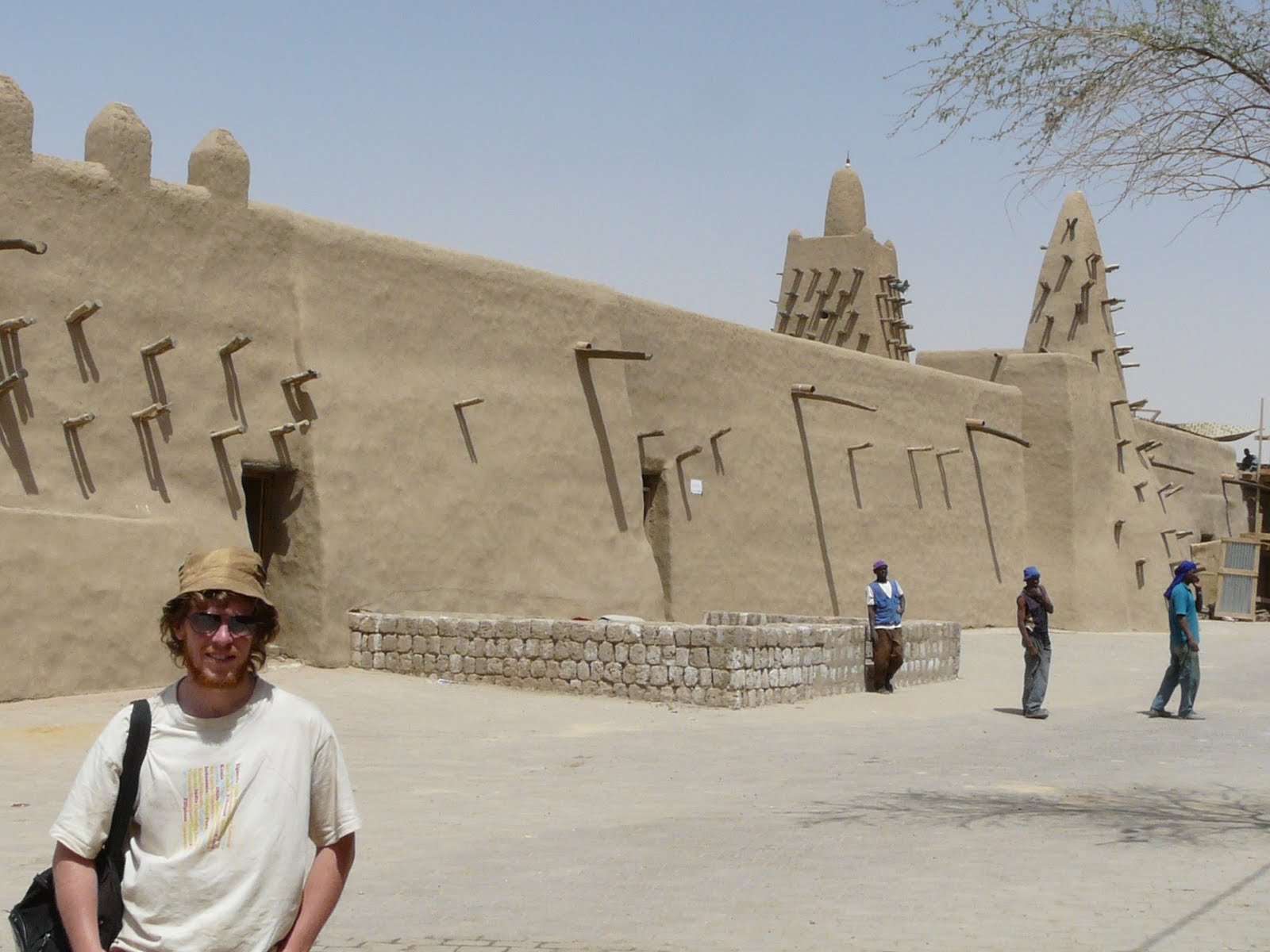 Dyingerey Ber Mosque
 Discovering Tombouctou
 Tombouctou streets
 The Grand Mosque, Tombouctou on the site of the world's first university
 Linda sharing Malian tea in the desert.
 Camel trip with the Tuaregs
There's another new post below this one - keep reading!
The journey south
Deep in the Sahara desert, salt is mined and carried in slabs by camel caravans to Tombouctou (Timbuktu). From there it is transported by traditional wood and canvas boats called pinasses down the Niger river to Mopti. This route and method have changed little in hundreds of years despite the advances of modern technology.
For one week in March, the 2 pinasses of Aliyou Hamadoun carried 30 tonnes of salt, 10 tonnes of grain, several baskets of dried fish, 2 Malian families, 1 BMW R1100GS and 2 sunburnt Irish adventurers along this famous route.
March is in the dry season in Mali and the resultant low water levels cause problem for the navigation of these boats. Sandbanks lurk just beneath the surface. The drivers (Bozo people) know every inch of their river, having lived in harmony with the river for generations. They weave paths between the sandbanks, which is particularly challenging at nightfall! We were prepared for a journey of 3 days and 2 nights, and had the appropriate rations of drinking water and biscuits that we felt would safely see us throught the trip. 7 nights later, thanks to low water levels, and many large sandbanks, we whooped songs of joy as the lights of Mopti were visible in the distance. We were worried that we might be hallucinating, as we had become accustomed to the slow pace of life - early mornings, early nights, no lights in the river villages and a distinct lack of consumer goods (the ubiquitous Coca Cola signs)! The most challenging aspect was never knowing when we'd get to Mopti. Mike might disagree, and say the most challening aspect was being roused at 6am to jump into the river and start pushing the pinasse as we hit yet another sandbank. Mike shattered any colonial myth that the white man lies relaxing on the boat while allowing the natives to do the hard physical work. I, on the other hand, was happy to abandon my feminist principles, and allow the men to push us out of difficulty on every occasion!
Our pinasse carried a family of 2 brothers, the wife of one of them, and 4 children (age 6,9, 11, 14). We soon discovered this was their home. The children's school and playground was the 80 ft pinasse, complete with cargo. The river was their home, and providesd all they appeared to need. The river served as toilet, shower, washing machine, dishwasher, cooking water, drinking water and rubbish bin. They treated us as part of the family, and provided us with 3 meals a day (rice, rice and rice - with fish and gravy for lunch!) You know you're really considered a big sister when you go to the part of the pinasse where the toilet bucket is kept, and you're no longer afforded any privacy, but instead jokingly poked in the arm and told to hurry up!
The kids were completely fascinated by us. They were quite shy at first, and seemed genuinely afraid when I sang a song and tried to play a clapping game with one of them. They spoke only their own language (Sorhei), whereas almost all Malians speak quite good French. We assume this was because, like their parents before them, they had never been to school. It was surprisingly difficult to communicate with kids that age. We couldn't kick a football with them, and the signs we used and thought were universal didn't see to be understood. Eventually we discovered playing cards, and taught them a variety of games, and how to count to 10 in French. I was also quite touched when they named their doll Linda in my honour!
It was a facinating trip watching the steady stream of fisherman in their pirogues and similar cargo pinasses. We gained some insight into traditional village life along the Niger, were in awe at our first sightings of hippos in the wild, and captivated by the beautiful birdlife passing overhead. So, we were glad it took that little bit longer than planned. And we survived with the daily meals and the water and biscuits we had. You see, being Westerners, one always assumes you need more than you actually do!!

Our boat on the right, the bike's on the left.
 Linda relaxing on a bed of salt slabs. (That's a faded Malian flag, not an Irish one!)
 An Capall as cargo.
 Niger by night.
 Hippos out for an evening
 Typical river-side life.
 Wild Irish fisherman pushing the Pinasse
 In Mopti, we negotiated with 5 men for them to lift An Capall from the pinasse back to dry land. From here, with 2 sets of stiff legs, we rode to Bandiagara. This is the gateway to Dogon country, where we undertook a 3 day trek through intriguing villages built along the top and foot of an 80 metre high escarpement. The Dogon region has held fast to traditional ways of life. The religion is Animism (worship of ancestors and nature), and gender roles are clearly delineated. The men hold village meetings in low roofed woden structures: so low you have to crouch when inside, thereby eliminating any possibility of fighting. A woman's primary role is to reproduce, and the Dogon women are strong - grinding millet, carrying branches on their heads, usually while pregnant and with another baby strapped to their backs! Life in post-recession Ireland never looked so appealing! The scenery was absolutely breathtaking, and at times reminded us of the Burren in County Clare and the Kimberleys in Australia. We were treated to traditional dancing (very fast footwork!) and our guide introduced us to some fascinating old village people. The kids had no problem in introducng themslves to us. Mike says I look like a female Jesus with dozens of kids trailing behind me!
We've now crossed into Burkina Faso. More details on this beautiful country soon.........
 Dogon village
 Linda and our guide, David about to tackle the steep descent down the escarpement.
 Road out of Mali and into Burkina Faso
Saturday 27 March 2010
Toubabs and Tuaregs in Timbuktu!
Bandiagara, Mali. 6080 miles by road / 350 miles by river!
Africa can't be tamed.
As soon as you think that you're getting a handle on it, it throws something new and unexpected in your path.
There are clocks here but they seem irrelevant as Africa runs to its own beat and all you can do is listen and wait and fall into its rhythm.
Since we last wrote, the adventures have come at us faster than we could imagine.
After Bamako, we followed the path of the Niger river to the historic towns of Segou and Djenne.
Segou was where the Scottish exlorer, Mungo Park first stood at the banks of the Niger and determined it's west-east flow. As we had breakfast on a terrace watching the fishermen push the pirogues out, the current was so gentle that the morning breeze pushed the waves upstream.
Djenne is an island town of mud walled buildings. The centre piece is the 5 story mud walled mosque towering over the market square like a dirt fairytale castle.
We crossed onto the island by means of a small car ferry. But being Africa, the ferry docked straight onto soft sand of the beach.
I've mentioned my interest in riding on soft sand already and when we were leaving the island the soft sand played it's part in a dramatic exit.
The ferry couldn't dock properly so the driver dropped both ramps steeply down into the water about 3 metres from the waters edge.
This required the vehicles to take run at the ferry, through the soft beach sand, into the water on the softer sand and thump, up onto the ramps.
Linda dismounted and pointed the camera.
I lined up; held my breath and let the clutch out.
The sand was fine, the water was grand. but when the front wheel hit the ramp the Capall reared up onto its rear wheel and came down at an angle on the ramp.
At this stage, the bike was only half on the ramp and I was commited so I kept the power on.
The rear wheel hit, to similar effect and bounced the bike even more towards the gap between the ramps.
It did briefly occur to me that this mightn't be my finest moment in biking; just as the front wheel fell off the ramp.
For a Walt Disney minute, the bike dangled with the front wheel out over the water and yours truly leaning back hard, until about 10 local men swarmed the bike and we picked it up back onto the ramp.
Somehow, the only casualty other than the blood vessels in my face, were the front bash plate mounts which did their job and protected the engine.
Two days later we were in Douentza.
From here we headed north off the tarmac on the 150 miles towards Timbuktu.
Timbuktu is that semi-mythical town that we've all heard of but don't think it real.
It had drawn explorers from Europe as far back as the 15th century and most didn't return.
It's not as difficult to reach now but it still ain't no picnic!
We had heard discouraging stories about this section of piste and very quickly found out that they were all true.
Put simply, it was the worst 150 miles I have ever driven.
Many years of heavy trucks had pushed the hard packed dirt of the road into a series of corrugations.
The locals call them escalier (steps) and they were the same effect as driving on 150 miles of cattle grids.
We took three days, cheering when we reached another stone marker telling us that we had just passed another 5 km in the prevous 20 minutes.
At the end of the first day and 60 miles, we rolled into the town on Bambara-Maounde. We were grateful for the stop and the cold drinks but mightily confused as Bambara-Maounde was about 40 miles due east of where the map said we should be.
Africa was up to its old tricks; in this case our Mali map, drawn in 1985, updated in 1992 basically showed the road going the wrong way.
We're still not sure where we actually went but we were always happy as long as the 5km stone marker kept appearing. Every 20 minutes........
As I started the bike in the morning at Bambara; the oil level indicator window blew out the side of the engine with most of the oil following it.
I couldn't blame it - I wasn't too keen on setting off on more of the same track either.
About an hour later, it was back in place with chemical metal and instant gasket but this was a very lucky save. If this had blown out while we were on the road, the first I would have known would be that sound of pistons welding themselves to cylinders followed by a bang and then silence.
On the third day we entered Timbuktu.
Even after being there, it's still semi-mythical.
Narrow alleys led a labryth through mud-walled building which haven't changed in 1000 years.
Tribes and ethnicities meet and mix; Songhei, the orignal settlers; Fulani and Sorhei, the river people; Tuaregs, the blue-robed nomads of the desert; and Toubabs, us!
Since Senegal, every child that sees us shouts "Toubab, Toubab"! At first we thought it meant hello or welcome, but eventually discovered it meant, simply and accurately, White Person.
And that's how we're known. Children seem to be able to call Toubab before they can walk and it's the backdrop chorus everywhere we go.
Timbuktu is on the edge of the desert and we took a trip into dunes in a way that The Capall couldn't manage. We took the original ship of the desert and tried not to fall off the back of wo camels.
The reference to ship must be because of the up and down motion the rider feels when they walk.
We have a lot more to tell but to give my fingers and your eyes a rest, I'll finish this post now.
We're leaving for Burkina Faso tomorrow but when we get there we'll tell you about the 350 miles by river! And no, I didn't drop the bike in the water.........
Africa can't be tamed.
As soon as you think that you're getting a handle on it, it throws something new and unexpected in your path.
There are clocks here but they seem irrelevant as Africa runs to its own beat and all you can do is listen and wait and fall into its rhythm.
Since we last wrote, the adventures have come at us faster than we could imagine.
After Bamako, we followed the path of the Niger river to the historic towns of Segou and Djenne.
Segou was where the Scottish exlorer, Mungo Park first stood at the banks of the Niger and determined it's west-east flow. As we had breakfast on a terrace watching the fishermen push the pirogues out, the current was so gentle that the morning breeze pushed the waves upstream.
Djenne is an island town of mud walled buildings. The centre piece is the 5 story mud walled mosque towering over the market square like a dirt fairytale castle.
We crossed onto the island by means of a small car ferry. But being Africa, the ferry docked straight onto soft sand of the beach.
I've mentioned my interest in riding on soft sand already and when we were leaving the island the soft sand played it's part in a dramatic exit.
The ferry couldn't dock properly so the driver dropped both ramps steeply down into the water about 3 metres from the waters edge.
This required the vehicles to take run at the ferry, through the soft beach sand, into the water on the softer sand and thump, up onto the ramps.
Linda dismounted and pointed the camera.
I lined up; held my breath and let the clutch out.
The sand was fine, the water was grand. but when the front wheel hit the ramp the Capall reared up onto its rear wheel and came down at an angle on the ramp.
At this stage, the bike was only half on the ramp and I was commited so I kept the power on.
The rear wheel hit, to similar effect and bounced the bike even more towards the gap between the ramps.
It did briefly occur to me that this mightn't be my finest moment in biking; just as the front wheel fell off the ramp.
For a Walt Disney minute, the bike dangled with the front wheel out over the water and yours truly leaning back hard, until about 10 local men swarmed the bike and we picked it up back onto the ramp.
Somehow, the only casualty other than the blood vessels in my face, were the front bash plate mounts which did their job and protected the engine.
Two days later we were in Douentza.
From here we headed north off the tarmac on the 150 miles towards Timbuktu.
Timbuktu is that semi-mythical town that we've all heard of but don't think it real.
It had drawn explorers from Europe as far back as the 15th century and most didn't return.
It's not as difficult to reach now but it still ain't no picnic!
We had heard discouraging stories about this section of piste and very quickly found out that they were all true.
Put simply, it was the worst 150 miles I have ever driven.
Many years of heavy trucks had pushed the hard packed dirt of the road into a series of corrugations.
The locals call them escalier (steps) and they were the same effect as driving on 150 miles of cattle grids.
We took three days, cheering when we reached another stone marker telling us that we had just passed another 5 km in the prevous 20 minutes.
At the end of the first day and 60 miles, we rolled into the town on Bambara-Maounde. We were grateful for the stop and the cold drinks but mightily confused as Bambara-Maounde was about 40 miles due east of where the map said we should be.
Africa was up to its old tricks; in this case our Mali map, drawn in 1985, updated in 1992 basically showed the road going the wrong way.
We're still not sure where we actually went but we were always happy as long as the 5km stone marker kept appearing. Every 20 minutes........
As I started the bike in the morning at Bambara; the oil level indicator window blew out the side of the engine with most of the oil following it.
I couldn't blame it - I wasn't too keen on setting off on more of the same track either.
About an hour later, it was back in place with chemical metal and instant gasket but this was a very lucky save. If this had blown out while we were on the road, the first I would have known would be that sound of pistons welding themselves to cylinders followed by a bang and then silence.
On the third day we entered Timbuktu.
Even after being there, it's still semi-mythical.
Narrow alleys led a labryth through mud-walled building which haven't changed in 1000 years.
Tribes and ethnicities meet and mix; Songhei, the orignal settlers; Fulani and Sorhei, the river people; Tuaregs, the blue-robed nomads of the desert; and Toubabs, us!
Since Senegal, every child that sees us shouts "Toubab, Toubab"! At first we thought it meant hello or welcome, but eventually discovered it meant, simply and accurately, White Person.
And that's how we're known. Children seem to be able to call Toubab before they can walk and it's the backdrop chorus everywhere we go.
Timbuktu is on the edge of the desert and we took a trip into dunes in a way that The Capall couldn't manage. We took the original ship of the desert and tried not to fall off the back of wo camels.
The reference to ship must be because of the up and down motion the rider feels when they walk.
We have a lot more to tell but to give my fingers and your eyes a rest, I'll finish this post now.
We're leaving for Burkina Faso tomorrow but when we get there we'll tell you about the 350 miles by river! And no, I didn't drop the bike in the water.........
Friday 5 March 2010
Some more photos
We've found a decent internet connection so we're finally putting up some photos.
 Malian village off the beaten track with great kids.
 Senegal dust.
 Fixing the Capall in Chefchaouen, Morocco.
  Charming the snakes in Marrakesh?
 Marrakesh sunset.
 Mauritania. Sahara. Linda. Camels. Sand.
 Impromptu music with Mauritanian holy men.
 Linda surrounded by Senegalese kids in St Louis.
 Parque de Langue de Barbarie, Senegal.
 Linda being taught how to cook, Senegalese style. Louga.
 Kids!
Kids!Thursday 4 March 2010
Dust and duct tape.
Bamako, Mali. 5220 miles from home.
Heat.
Habits learned in north Europe cause you to wait for the water to heat up before you step in.
Then you remember this is Africa and although hot water is unlikely, you really wish the water will stay cold.
It feels like the water has soap already mixed but it's actually the perfect film of sweat covering you.
This is 9am. If you left it any later to get out of the tent, the heat inside would start to drain whatever energy you have.
Bamako
Bamako is pure Africa. The city heaves in the heat as thousands of mopeds, laden with over-sized boxes buzz around while the crowds mill in the markets. Everything and everyone seems to be moving but the speed of the vehicles is offset by the deliberate, slow pace of the pedestrians. A slow pace to conserve energy in the sweltering temperature.
We're camped by the Niger. It's wide with many little islands and for me it's difficult to reconcile how easy it was for us to travel here with the many Europeans explorers who died trying to find this river 200 hundred years ago.
The other paradox is that while in many ways, this is a modern city, 60 miles from here people are eking out an existence on arid dusty land.
Driving
When we were planning this trip, we looked at maps of the continent with roads marked as being passable only in the dry season.
I wondered how the bike would hold up and I wondered how I would hold it up on the sand and gravel.
I have to say that our overall feeling has been one of surprise at how easy it has been.
That's not boastful - it's simply that the road conditions range between ok and perfect!
We've ridden over 5220 miles. In total, approximately 60 miles of that have been piste (dirt track). The rest has been asphalt with much of it billiard table smooth.
The bits that challenge can be grouped like this.
Non main roads into villages. These are usually dirt and dust but the surface is consistent and easy.
No Mans Land or either side of a border crossing. These are the worst roads as neither government wants to spend money for the other to benefit.
Road works where the traffic is diverted off the main road onto piste.
Towns! The lesser streets in most towns are dust, dirt and sand. Junctions are the worst where the sand is twice as deep.
I'm happy driving on the dirt and dust but the deep sand is horrible.
When we were planning how to load the bike we tried to keep the weight as even as possible between the wheels, but the natural and easiest place to put stuff is towards the rear.
So, especially when the fuel is low in the petrol tank, the bike is weighted toward the rear.
On most surfaces it's no problem whatsoever but in sand the rear wheel digs down and the front wheel lifts out and starts acting like a rudder.
At these moments, poor Linda has to hop off and walk past the difficult section. I stand on the pegs, leaning forward, let the clutch out quickly and power forward at 20kph with a spray of sand behind.
Dangers on the road? No.
We'd heard horror stories about the driving standards in Africa. This is our fourth contry and so far it's been grand.
Taxi drivers don't use the rules of the road but what's new there?
The main thing we've been watching for are livestock wandering on the road.
Cows, camels and pigs are easy to deal with as they lumber slowly across.
Goats scamper as soon as they hear the bike or the beep of the horn.
Donkeys are the most troublesome. They move quickly and usually at inappropriate moments.
Our nearest miss was a trio of suicidal donkeys who threw themselves in front of An Capall as if they were part of a Donkey Suffragette Movement.
The heat is the biggest factor for us to deal with. Our thermometer was reading 43 degrees yesterday and that's with the wind blowing over it.
Actually the wind is hot. When I open the visor of my helmet, I feel like I'm checking to see if a roast chicken is cooked.
We changed Linda's helmet to open-face which has cooled her down.
However, with the thick dust and the sweat and sunblock on her face, when she takes off the helmet she looks like a 1950's racing driver. As if I don't find her attractive already!
An Capall Mor
The bike is holding up the finest.
Three of the four indicators are held on with duct tape and the neutral light sometimes appears in 1st gear but that's the sum total of problems.
The off-road tyres are wearing but not significantly.
We've cleaned the air filter but haven't needed to change it. That surprised us as the dust is so thick.
Duct tape has been a major part of the journey.
It's held on bits of helmets, blocked holes in tubes of glue and in mosquito nets, holds on the intercom leads to our helmets, sealed the sides of the toolbox, stuck sunglasses together, and hold bits that we are finished with, but need to keep under the boxes.
Washing
The dust gets everywhere.
We ran out of clean(ish) clothes yesterday and so spent 4 hours hand scrubbing today.
And I mean scrubbing!
Hello
Finally, but certainly not leastly, a special hello has to go Baby Molly and Baby Jack who made their appearances in the last few weeks.
Welcome to this cool world and we look forward to having a chat with you when we get back!
Heat.
Habits learned in north Europe cause you to wait for the water to heat up before you step in.
Then you remember this is Africa and although hot water is unlikely, you really wish the water will stay cold.
It feels like the water has soap already mixed but it's actually the perfect film of sweat covering you.
This is 9am. If you left it any later to get out of the tent, the heat inside would start to drain whatever energy you have.
Bamako
Bamako is pure Africa. The city heaves in the heat as thousands of mopeds, laden with over-sized boxes buzz around while the crowds mill in the markets. Everything and everyone seems to be moving but the speed of the vehicles is offset by the deliberate, slow pace of the pedestrians. A slow pace to conserve energy in the sweltering temperature.
We're camped by the Niger. It's wide with many little islands and for me it's difficult to reconcile how easy it was for us to travel here with the many Europeans explorers who died trying to find this river 200 hundred years ago.
The other paradox is that while in many ways, this is a modern city, 60 miles from here people are eking out an existence on arid dusty land.
Driving
When we were planning this trip, we looked at maps of the continent with roads marked as being passable only in the dry season.
I wondered how the bike would hold up and I wondered how I would hold it up on the sand and gravel.
I have to say that our overall feeling has been one of surprise at how easy it has been.
That's not boastful - it's simply that the road conditions range between ok and perfect!
We've ridden over 5220 miles. In total, approximately 60 miles of that have been piste (dirt track). The rest has been asphalt with much of it billiard table smooth.
The bits that challenge can be grouped like this.
Non main roads into villages. These are usually dirt and dust but the surface is consistent and easy.
No Mans Land or either side of a border crossing. These are the worst roads as neither government wants to spend money for the other to benefit.
Road works where the traffic is diverted off the main road onto piste.
Towns! The lesser streets in most towns are dust, dirt and sand. Junctions are the worst where the sand is twice as deep.
I'm happy driving on the dirt and dust but the deep sand is horrible.
When we were planning how to load the bike we tried to keep the weight as even as possible between the wheels, but the natural and easiest place to put stuff is towards the rear.
So, especially when the fuel is low in the petrol tank, the bike is weighted toward the rear.
On most surfaces it's no problem whatsoever but in sand the rear wheel digs down and the front wheel lifts out and starts acting like a rudder.
At these moments, poor Linda has to hop off and walk past the difficult section. I stand on the pegs, leaning forward, let the clutch out quickly and power forward at 20kph with a spray of sand behind.
Dangers on the road? No.
We'd heard horror stories about the driving standards in Africa. This is our fourth contry and so far it's been grand.
Taxi drivers don't use the rules of the road but what's new there?
The main thing we've been watching for are livestock wandering on the road.
Cows, camels and pigs are easy to deal with as they lumber slowly across.
Goats scamper as soon as they hear the bike or the beep of the horn.
Donkeys are the most troublesome. They move quickly and usually at inappropriate moments.
Our nearest miss was a trio of suicidal donkeys who threw themselves in front of An Capall as if they were part of a Donkey Suffragette Movement.
The heat is the biggest factor for us to deal with. Our thermometer was reading 43 degrees yesterday and that's with the wind blowing over it.
Actually the wind is hot. When I open the visor of my helmet, I feel like I'm checking to see if a roast chicken is cooked.
We changed Linda's helmet to open-face which has cooled her down.
However, with the thick dust and the sweat and sunblock on her face, when she takes off the helmet she looks like a 1950's racing driver. As if I don't find her attractive already!
An Capall Mor
The bike is holding up the finest.
Three of the four indicators are held on with duct tape and the neutral light sometimes appears in 1st gear but that's the sum total of problems.
The off-road tyres are wearing but not significantly.
We've cleaned the air filter but haven't needed to change it. That surprised us as the dust is so thick.
Duct tape has been a major part of the journey.
It's held on bits of helmets, blocked holes in tubes of glue and in mosquito nets, holds on the intercom leads to our helmets, sealed the sides of the toolbox, stuck sunglasses together, and hold bits that we are finished with, but need to keep under the boxes.
Washing
The dust gets everywhere.
We ran out of clean(ish) clothes yesterday and so spent 4 hours hand scrubbing today.
And I mean scrubbing!
Hello
Finally, but certainly not leastly, a special hello has to go Baby Molly and Baby Jack who made their appearances in the last few weeks.
Welcome to this cool world and we look forward to having a chat with you when we get back!
Monday 22 February 2010
Ah lads, where do we even begin to summarise the past 2 weeks? Since our last blog, we've had 2 border crossings, seen a LOT more desert, tested the resilience of an Capall and met many interesting people!
We're currently in dusty, hot Tambacounda in Senegal and it really feels like we're surrounded by images of the "Africa" that one imagines when you heard that word; We're out of the Maghreb, past the Sahara desert and are now immersed in greenery. We've seen our first African monkeys, are surrounded by women carrying babies on their backs and buckets on their heads and the boisterous warmth of the people greets us everywhere.
On our last day in Western Sahara we covered close to 400 km. We came upon a man walking along the road in the desert. He didn't look like a camel herder, and the passing cars didn't stop for him. We stop to chat and offer him some water and food. He was a small 64 year old Tunisian man. I asked "Where are you walking now?" "Mauritania" he replies, in earnest. We've just seen a sign say it's 334 km to the border.......!!!! He explained that he was robbed somewhere in Morocco, and so had to walk to Mauritania, where he had some friends. If only we had a sidecar we could have given him a lift. Hopefully someone else did!
We spent 5- 6 days in Mauritania. Desert every inch of the way until close to the Senegal border. Beautiful driving along with soft sand as far as the eye can see, camels and small settlements appearing quite frequently. It's hard to comprehend how people live there. What's also hard to comprehend is seeing a lone image on the road in the distance, and you think "Oh, another motorbike". No, it's a man cycling a bicycle through the Sahara!!! Pushing the boundaries of adventure travelling I would think! Filled with feelings of laziness and guilt we stopped and offered some of our precious water supplies. "Sahara beautiful", he says as he tells of his plans to cycle to South Africa! He's not even sweating, or out of breath. Respect.
We've slept in a range of interesting places:
We're currently in dusty, hot Tambacounda in Senegal and it really feels like we're surrounded by images of the "Africa" that one imagines when you heard that word; We're out of the Maghreb, past the Sahara desert and are now immersed in greenery. We've seen our first African monkeys, are surrounded by women carrying babies on their backs and buckets on their heads and the boisterous warmth of the people greets us everywhere.
On our last day in Western Sahara we covered close to 400 km. We came upon a man walking along the road in the desert. He didn't look like a camel herder, and the passing cars didn't stop for him. We stop to chat and offer him some water and food. He was a small 64 year old Tunisian man. I asked "Where are you walking now?" "Mauritania" he replies, in earnest. We've just seen a sign say it's 334 km to the border.......!!!! He explained that he was robbed somewhere in Morocco, and so had to walk to Mauritania, where he had some friends. If only we had a sidecar we could have given him a lift. Hopefully someone else did!
We spent 5- 6 days in Mauritania. Desert every inch of the way until close to the Senegal border. Beautiful driving along with soft sand as far as the eye can see, camels and small settlements appearing quite frequently. It's hard to comprehend how people live there. What's also hard to comprehend is seeing a lone image on the road in the distance, and you think "Oh, another motorbike". No, it's a man cycling a bicycle through the Sahara!!! Pushing the boundaries of adventure travelling I would think! Filled with feelings of laziness and guilt we stopped and offered some of our precious water supplies. "Sahara beautiful", he says as he tells of his plans to cycle to South Africa! He's not even sweating, or out of breath. Respect.
We've slept in a range of interesting places:
- A Berber tent at the Western Sahara/Mauritanian border
- Pitching our tent in the soft sand of the desert sleeping to the sound of camels (Noisy creatures that Mike aptly describes as sounding like a cross between an anxious donkey and a squeaky wheelbarrow!)
- A mattress on the roof of a hostel in Nouakchott, Mauritania
- We got to Kaolack, Senegal late and every hotel was full because of festivals. A hotel owner who spoke English with a New York accent, gave us a mattress on the roof terrace and allowed us stay for free, with free breakfast in the morning.
Memorable encounters have included:
- I went to a shop to buy bread and ending up sipping Mauritanian tea in the local shop while discussing Chris de Burgh with a local man in broken French (mine, not his)!
- Mike was sitting on the bike at the only shop for 200 km on the main road through Mauritania. 12 holy men men in full white robe approached, shook hands and broke into song.
- I was sitting on a bench in St Louis. Suddenly a small girl of 3 is shaking my hand. 2 seconds later: 14 girls aged 2 to 16 are sitting around me. My hair's plaited before I can catch my breath. I'm sprouting newly-taught Wolof (one of the Senegalese naitonal languages) phrases and the grils are hysterically laughing at my poor pronunciation!
- We stopped in Louga, Senegal for lunch. Everything was closed for preparations for a religious festival. We were waved across the road to a bunch of people sitting under a canopy. Within minutes we're surrounded by kids and then I joined the women and was invited to stir the massive pot of rice and beef. Mike spent the hour taking pictures of the kids and showing them the photos on the camera.
Okay, as seems to be the way of it, the only internet cafe we've found in a week is closing now so I must sign off.
Talk to you from Mali with more details
Sunday 14 February 2010
Edge of the Continent
Hi,
Just a few photos to keep you going.
We're having problems with the internet connection here so can't upload more.
We've travelled just under 1000 miles since we last wrote.
We've stayed in Agadir, Tan-Tan and Boujdour and tonight we're staying in Dakhla.
We've followed the coastline and for the last 3 days we've been riding with the Atlantic on our right and the Sahara on our left!
Photos nor words can really do justice to the awe-inspiring vastness of the desert.
Much of the desert so far has been what's called Hammada which is a dusty stony harsh landscape.
We've seen huge canyons, vast flat plains stretching to the horizon and herds of camels.
The road has been great but today, we took the bike off into the sand and rode parallel to the tarmac, just for the fun of it.
It's getting late now so we'll sign off.
Take care.
 Hotel with secure parking!
Rolling out of the foyer backwards in the morning.
 Wildlife. And camels.
 Playing in the sand
 Where the desert meets the ocean.
Wednesday 10 February 2010
Rabat, Casablanca and Marrakesh
We're finally getting some decent miles under our belt and seeing more of the country.
We've now travelled 2355miles from home.
We were up early on Monday morning as we had to be at the Mauritanian embassy in Rabat to submit our visa application .
After manouevring the bike out the hotel front door we set off amid a torrential downpour.
All the guidebooks recommend dressing reasonably smartly when visiting national embassies, but luckily for us, the Mauritanian official seemed perfectly happy to deal with two sodden dirty bikers.
After a very pleasant day strolling through Rabat, we picked up the Mauritanian visa at 4.30 and reached Casablanca at 5.30pm.
Casablanca was a short stop as we left the next morning heading for Marrakesh.
We deliberately stayed off the motorway and it was a great decision.
The road surface was silky all the way and we crossed wide flat plains occasionally interspersed with smooth constant radius curves through hills.
Berrechid and Settat were two fabulously maintained towns we travelled through where the French influence of wide palm-tree-lined boulevards was obvious.
We're now in Marrakesh and it makes reality of the Moroccan Tourist Board advertising phrase, 'A Feast For The Senses'.
Place Djamma-El-Fna is the central square and from dusk it fills with food stalls and their associated smells and smoke, musicians, street entertainers, story tellers, and snake charmers.
My favourite memory of the last few days came while we were in Settat.
We stopped to chck the map and an old man came over and volunteered directions for Marrakesh.
Then he sent us on our way with a cheerful 'Bonne Route', as we have heard so many times, and with a slight bow, 'Allez avec plaisir'.
We've now travelled 2355miles from home.
We were up early on Monday morning as we had to be at the Mauritanian embassy in Rabat to submit our visa application .
After manouevring the bike out the hotel front door we set off amid a torrential downpour.
All the guidebooks recommend dressing reasonably smartly when visiting national embassies, but luckily for us, the Mauritanian official seemed perfectly happy to deal with two sodden dirty bikers.
After a very pleasant day strolling through Rabat, we picked up the Mauritanian visa at 4.30 and reached Casablanca at 5.30pm.
Casablanca was a short stop as we left the next morning heading for Marrakesh.
We deliberately stayed off the motorway and it was a great decision.
The road surface was silky all the way and we crossed wide flat plains occasionally interspersed with smooth constant radius curves through hills.
Berrechid and Settat were two fabulously maintained towns we travelled through where the French influence of wide palm-tree-lined boulevards was obvious.
We're now in Marrakesh and it makes reality of the Moroccan Tourist Board advertising phrase, 'A Feast For The Senses'.
Place Djamma-El-Fna is the central square and from dusk it fills with food stalls and their associated smells and smoke, musicians, street entertainers, story tellers, and snake charmers.
My favourite memory of the last few days came while we were in Settat.
We stopped to chck the map and an old man came over and volunteered directions for Marrakesh.
Then he sent us on our way with a cheerful 'Bonne Route', as we have heard so many times, and with a slight bow, 'Allez avec plaisir'.
Saturday 6 February 2010
In the words of Willie Nelson.....
On The Road Again
It's 6.30pm; we're in the centre of our first capital city of the trip; African rush hour is in full swing; we're stopped at a busy junction; horns are blowing; mopeds are buzzing; pedestrians are flooding the road; what road-signs we can see are in Arabic; Linda's scanning for anything resembling a street name that's on our map, which she's holding on her lap; I'm trying to figure who has right of way......and the traffic lights are broken!
Ha ha, this madness is what it's all about. This is what we came for!!!
We're now in Rabat on the western coast of Morocco and after our 11 days sojourn in Chefchaouen we got moving again this morning.
The last week has been a strange mix of ups, downs and a lot of waiting.
We spent last weekend in Meknes and Fes.
As Linda described, Meknes was a wonderful transport back in time.
Fes was the same, just on a bigger scale!
If the best way to see a country is to meet the people, then the best way to meet the people is to look for a service which usually only locals need.
On the day we left Limerick, the zip in our tank bag split and has been a bit of a pain since.
We reckoned that if we could get it fixed anywhere, it would be in the busy backstreet stalls where everything is mended and nothing is disposible.
After a bit of a search, we met a lovely quiet man who runs a small wooden-doored stall, stuffed with zips, button and fasteners; we call it The Zippery.
A little chat about our problem and following 20 minutes of deft fingerwork, our bag was like new.
We returned to Chefcahouen and to our injured Capall on Tuesday.
We were waiting for 1 parcel of parts from Ireland and 1 parcel couriered from the UK; both of which would have needed to have been collected at the post office.
Tuesday - nothing; hang around and revise plans.
Wednesday - hopes were raised by the arrival of the Irish parcel although nothing from the UK. Hang around and revise plans.
Thursday - hopes were knocked back down with no parcel from the UK. Hang around and revise plans.
Friday - Excitement as the UK parcel arrived at mid-day.
Suddenly, Friday became busy.
The next 2 hours were spent searching for a garage with a bearing puller and press large enough.
We eventually found one 3km outside the town and during a funny chat with the gregarious owner, we swapped the bearing, spacer and seals.
As I said, using a local service is the best....!
Linda and myself spent the rest of the evening putting the bike back together and taking the tent down.
We covered 170miles today and right from the camp-site gate we had mix of glorious sunshine, beautiful views and challenging roads!
We travelled from sinuous curves in the Rif mountains to large expanses of flat plains towards the coast.
Roads were interesting and testing including one section where Linda had to get off so I could 'paddle' the bike as it squirmed about in a muddy track.
The junction scene at the beginning of this post was what greeted us when we got to Rabat and it was all topped off by the fun of getting An Capall up two steps, in the front door of the hotel, down the corridor past the reception desk and into the inner court yard where it's safely tied down for the night!
It's 6.30pm; we're in the centre of our first capital city of the trip; African rush hour is in full swing; we're stopped at a busy junction; horns are blowing; mopeds are buzzing; pedestrians are flooding the road; what road-signs we can see are in Arabic; Linda's scanning for anything resembling a street name that's on our map, which she's holding on her lap; I'm trying to figure who has right of way......and the traffic lights are broken!
Ha ha, this madness is what it's all about. This is what we came for!!!
We're now in Rabat on the western coast of Morocco and after our 11 days sojourn in Chefchaouen we got moving again this morning.
The last week has been a strange mix of ups, downs and a lot of waiting.
We spent last weekend in Meknes and Fes.
As Linda described, Meknes was a wonderful transport back in time.
Fes was the same, just on a bigger scale!
If the best way to see a country is to meet the people, then the best way to meet the people is to look for a service which usually only locals need.
On the day we left Limerick, the zip in our tank bag split and has been a bit of a pain since.
We reckoned that if we could get it fixed anywhere, it would be in the busy backstreet stalls where everything is mended and nothing is disposible.
After a bit of a search, we met a lovely quiet man who runs a small wooden-doored stall, stuffed with zips, button and fasteners; we call it The Zippery.
A little chat about our problem and following 20 minutes of deft fingerwork, our bag was like new.
We returned to Chefcahouen and to our injured Capall on Tuesday.
We were waiting for 1 parcel of parts from Ireland and 1 parcel couriered from the UK; both of which would have needed to have been collected at the post office.
Tuesday - nothing; hang around and revise plans.
Wednesday - hopes were raised by the arrival of the Irish parcel although nothing from the UK. Hang around and revise plans.
Thursday - hopes were knocked back down with no parcel from the UK. Hang around and revise plans.
Friday - Excitement as the UK parcel arrived at mid-day.
Suddenly, Friday became busy.
The next 2 hours were spent searching for a garage with a bearing puller and press large enough.
We eventually found one 3km outside the town and during a funny chat with the gregarious owner, we swapped the bearing, spacer and seals.
As I said, using a local service is the best....!
Linda and myself spent the rest of the evening putting the bike back together and taking the tent down.
We covered 170miles today and right from the camp-site gate we had mix of glorious sunshine, beautiful views and challenging roads!
We travelled from sinuous curves in the Rif mountains to large expanses of flat plains towards the coast.
Roads were interesting and testing including one section where Linda had to get off so I could 'paddle' the bike as it squirmed about in a muddy track.
The junction scene at the beginning of this post was what greeted us when we got to Rabat and it was all topped off by the fun of getting An Capall up two steps, in the front door of the hotel, down the corridor past the reception desk and into the inner court yard where it's safely tied down for the night!
Subscribe to:
Posts (Atom)

